The tea sapling printer is dead; its night shift lives on
For five years the Tea Sapling turned roughly 85g of weeds into a 500g sale, with no energy cost and no daylight requirement. Version 1.6 cut the price to 250g. The Journal audited what the nerf destroyed, what it spared, and whether the old money printer still clears the bar of what else those clicks could do.
- The money printer is dead. Before 1.6, each craft added about 415g of value and a dedicated first month paid about 67,500g, arguably the strongest Year 1 opening in the game. At 250g the margin is 165g per craft and the same month pays roughly half.
- A very good side hustle survived. Each laundered forage item still becomes a 250g sapling, several times its raw price, earned with zero energy at any hour. It is no longer a main job; it is the best second shift in the game.
- It claims land nobody else wants. A self-seeding winter loop pays about 1,250g a week per ten tiles of otherwise dead winter dirt.
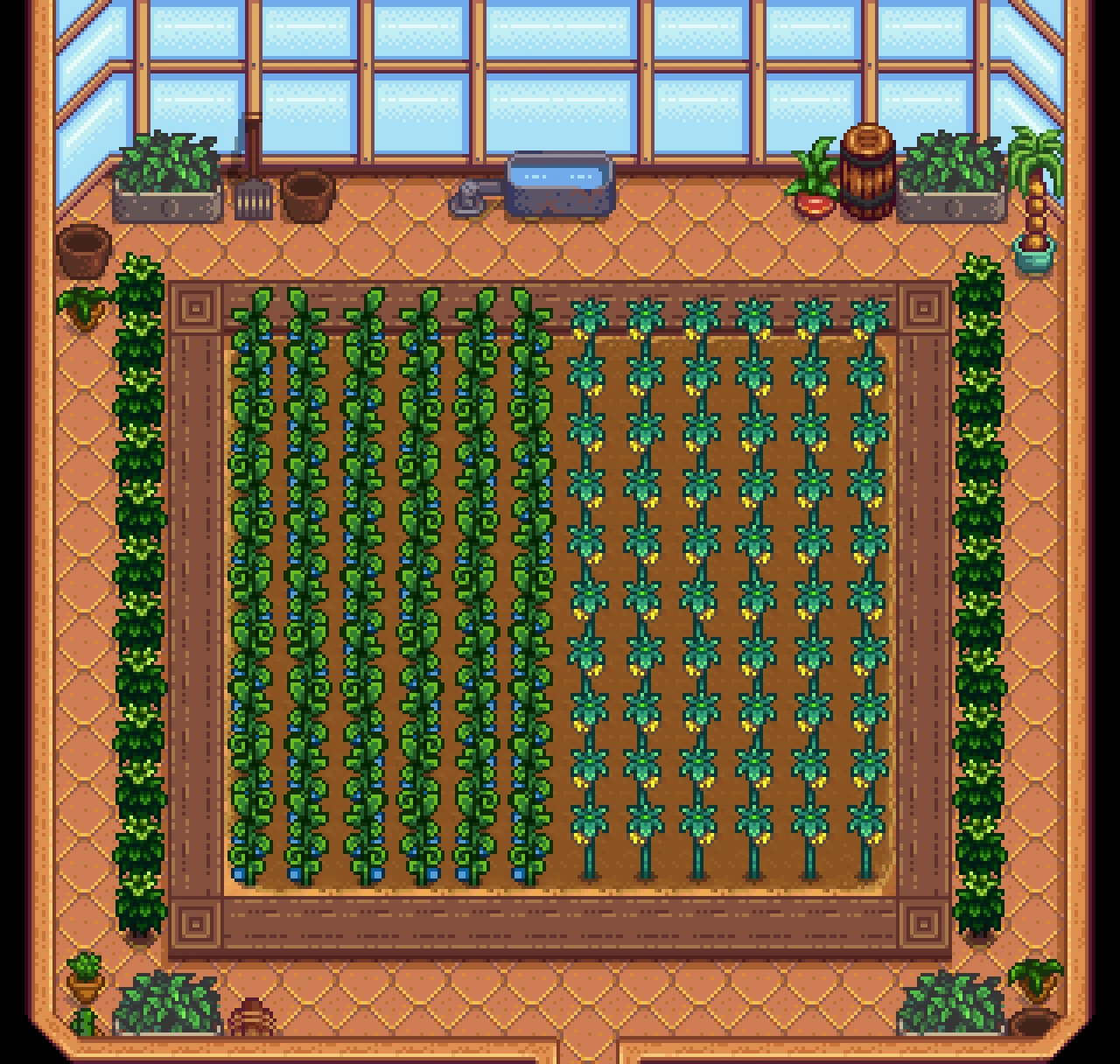
- One version was never nerfed. Tea bushes still grow on the greenhouse’s untillable border, dirt that otherwise holds nothing.
PELICAN TOWN – The Tea Sapling was the Valley’s most elegant exploit that was never technically an exploit. Two Wild Seeds, five Fiber, and five Wood, perhaps 85g of junk, crafted into an item that sold for 500g. The recipe cost no energy, needed no daylight, and had no cap but the farmer’s forage supply. Then version 1.6 cut the sale price to 250g. This report documents how the printer worked, audits what the nerf removed, and puts the surviving strategy to this paper’s action-budget test: does it survive contact with the question of what else those clicks could do?
§1The laundering chain
The recipe is 2 Wild Seeds of any season, mixable, plus 5 Fiber and 5 Wood, for one Tea Sapling selling at 250g in 1.6. Crafting costs no energy and works at any hour, including the dead minutes before 2 a.m. The recipe arrives by mail the day after Caroline’s two-heart event, which a farmer reaches with two liked gifts a week and daily conversation in about two weeks from a standing start, so the chain can be running by mid-spring of Year 1. Caroline likes the daffodils lying on the route.
Wild Seeds are the laundry. One of each of a season’s four forage items crafts into ten seeds; Spring’s recipe arrives at Foraging 1 and Fall’s at Foraging 7. Ten seeds make five saplings, so one full forage set becomes 1,250g of saplings from roughly 180g of vegetables, with fiber and wood as rounding errors at 1g and 2g apiece. The amplifier is the Seed Maker, which converts any single forage item into about two of its season’s Wild Seeds without a full set. One forage item in means one sapling out, which both scales the chain and unlocks it for lopsided inventories, such as forty winter roots and nothing else.
Gold of value added per player action, amortized over the full supply chain · central estimates · SDV 1.6
§2The 500g era, and the audit of the nerf
The documented pre-nerf route ran Saturday forage loops, since forage persists until Sunday, banked the Community Center’s 30 bonus Spring Seeds, and gathered about 270 seeds and about 675 each of fiber and wood in a month. It produced 135 saplings and 67,500g, rivaling anything in the early game. The 1.6 price cut halves the sale and removes about 60% of the margin: value added per craft falls from about 415g to about 165g, and per action, with the full chain amortized, from about 208g to about 83g. What the nerf did not touch is just as telling: the input costs, the zero energy, the no-daylight property, and the recipe’s absurd seed multiplication of four vegetables into ten seeds. ConcernedApe taxed the margin, not the mechanism.
Two of the paper’s own figures need reconciling on the page, and the desk shows both rather than choose. Its summary puts the dedicated first month at about 33,000g today, while its ledger halves the documented route to about 33,750g; the gap is rounding, and the ledger figure appears in the appendix. Its summary also describes “roughly 250g per laundered forage item,” while its ledger shows about 190g of value added per forage item through a Seed Maker. Both are correct measurements of different things: 250g is the sapling a forage item becomes, and 190g is what remains after the inputs are charged.
Value added, 500g era against 1.6 · per craft, per laundered forage, per action · SDV 1.6
§3Does it clear the bus fare bar?
As a main job, it does not. At about 1,200g a day on average, tea crafting no longer beats a dedicated Year 1 fishing day, which this paper’s bus fare report prices at about 1,800g. As a second job it clears the bar emphatically, because every step happens either in dead time, crafting at night with Seed Makers running unattended, or along routes the farmer walks anyway. The correct accounting charges tea almost no marginal daytime, which makes its effective rate per additional day close to unbounded. The bus fare report’s day template gains a line: machines first, the stage’s best active block second, and tea crafting while the day ends.
§4Running the chain in 1.6
The strongest modern use fills a gap this paper left open in its mixed seeds report, which ranked mainland winter as closed. Winter Seeds grow winter forage on mainland dirt that otherwise holds nothing. Plant ten Winter Seeds, harvest about ten forage items in seven days, run them through a Seed Maker into about twenty seeds, replant ten, and craft five saplings from the surplus. In steady state, each ten tiles pays about 1,250g a week, self-seeding, on land with no opportunity cost, with Botanist-iridium Winter Roots skimmed for the shipping bin whenever seed stocks run ahead.
For forage supply, the desk ranks planted Wild Seeds first, since they are the only scalable source and their quality rises with Botanist; Saturday map loops second, since spawns persist through Sunday and one weekly circuit catches nearly everything, which makes the Forest Farm the archetype’s home map. Salmonberry and blackberry weeks are not inputs, a common mix-up: bush berries make no Wild Seeds, and the chain accepts only each season’s four named forage items. Version 1.6 also opened a side door. At the Desert Festival, Caroline sells up to ten saplings for ten Calico Eggs, the game acknowledging the market it had just nerfed.
§5Sell the sapling, or plant it?
A planted bush takes 20 days to mature and then yields leaves only in the last week of each non-winter season, an annuity of about 8 to 11g per tile-day that loses to almost any crop. Planted outdoors it yields 21 leaves a year, about 2,900g as Green Tea; indoors, with a winter week added, 28 leaves, about 3,900g. Selling the sapling at once wins everywhere land has value. The exception is land that has none. Tea bushes can be planted on the greenhouse’s untillable border tiles, which hold no crops, no sprinklers, nothing. Two dozen bushes there are a free trickle of about 90,000g a decade plus a renewable Green Tea supply, worth +0.5 Speed in 1.6, and 1.6 also made the position liquid, since chopping a bush now refunds the sapling.
§6Special circumstances, and the verdict
The chain’s true calling is Year 1 capital formation. With the recipe by about Spring 12 and crafting through the 13th, tea gold arrives the night before the Egg Festival, whose strawberry seeds the bus fare report rates the best return on gold in Year 1; tea gold that night is worth more than double tea gold in any other week of the year. On days with one point of energy (after passing out, during Qi’s hungry challenge, or in the early tool grind) tea crafting is the only income that runs at full speed. A Tea Sapling is also a liked gift for most of the town, which makes the chain the cheapest scalable liked gift in the game at about 85g of inputs per 45 friendship points. It is not an artisan good, so neither Artisan nor Tiller multiplies the 250g, and it is no longer a reason to skip fishing.
The desk’s recommendation is to run tea as the farm’s night shift. Befriend Caroline in week one, craft every Wild Seed surplus into saplings at day’s end, feed every spare forage item through a Seed Maker first, run the self-seeding winter loop on ten otherwise dead tiles, line the greenhouse border with bushes that are never tended, and sell everything else the moment it is crafted. Expect about 1,000 to 1,500g a day of pure addition in Year 1, falling to pocket change by Year 2, at which point the chain retires into its second career as the town’s gift budget. The 500g version survived the action-budget test easily and was nerfed for exactly that reason; the 250g version survives because the honest price of its clicks is nearly zero. The best jobs in the Valley are the ones scheduled when the day is already spent.
M1 · The nerf ledger
| Line item | 500g era | 1.6 (250g) | Change |
|---|---|---|---|
| Sale price | 500 | 250 | −50% |
| Input sell value (2 Spring Seeds + fiber + wood) | ~85 | ~85 | 0 |
| Value added per craft | ~415 | ~165 | −60% |
| Value added per laundered forage (via Seed Maker) | ~440 | ~190 | −57% |
| Dedicated first month (135 saplings, documented route) | ~67,500 | ~33,750 | −50% |
| Gold per action, full chain amortized | ~208 | ~83 | −60% |
The paper’s summary rounds the 1.6 first month to ~33,000g; the ledger’s halved route gives ~33,750g. Both are shown.
M2 · Sell or plant
| Path | Returns | Gold per tile-day | Verdict |
|---|---|---|---|
| Sell immediately | 250g now, no tile | n/a | Default |
| Plant outdoors (leaves days 22–28, ×3 seasons) | 21 leaves/yr → Green Tea, ~2,900g/yr | ~8 | Poor |
| Plant indoors (adds winter week) | 28 leaves/yr → ~3,900g/yr | ~11 | Poor |
| Greenhouse border planting | same ~3,900g/yr on untillable edge tiles | ~11 on free dirt | Yes: 24+ bushes |
M3 · Methodology & sources
Recipe: 2 Wild Seeds (any) + 5 Fiber + 5 Wood; learned from Caroline’s 2-heart event; sapling sells 250g (reduced from 500g in 1.6; bushes refund saplings when chopped; Desert Festival sells 10 for 10 Calico Eggs). Wild Seeds: 1 of each of a season’s 4 forage items → 10 seeds; Seed Maker: 1 forage → avg ~2 seeds (97.5% of rolls 1–3). Input sell values: Spring Seeds 35, Fiber 1, Wood 2. Value added per craft = 250 − 85. Documented pre-nerf month: ~270 seeds, 135 saplings (stardewguide route), halved at current prices. Action amortization: ~3 actions per sapling full-chain (pickup, machine load/collect, craft) → ~83g per action at 250g. Bush annuity: 20-day maturation; leaves days 22–28 per non-winter season (+ winter indoors); Green Tea 100g base, ~140g Artisan, keg 180 min. Benchmarks in Fig. 24 come from this paper’s juice, fish pond, and bus fare reports and from the research series’ Crystalarium paper, not yet published as a Journal article. Sources: Stardew Valley Wiki (Tea Sapling, Wild Seeds, Seed Maker, Caroline); stardewguide.com’s documented 68k route.