Four fish ponds earn their dirt; the other two dozen are aquariums
Every farm builds one Lava Eel pond and then forgets the building exists. The Journal priced the whole league at population ten, roe pipeline included, and found a short list of real businesses, a long tail of decoration, and a Preserves Jar job that beats the celebrated pumpkin pickle.
- Lava Eel is the undisputed champion. A full pond grosses roughly 1,170g per pond-day with its roe aged under Artisan, about 47g per tile-day on land that needs no watering and works all winter.
- The second tier is the community’s blind spot. Ice Pip (~709) and Blobfish (~687) out-earn the Sturgeon (~665), which keeps its slot as the game’s only caviar mint. Below those four the chart falls off a cliff.
- Aged lava eel roe is the best jar job in the game. It adds 274g per jar-day, ahead of the pumpkin pickle, the benchmark this desk crowned in its juice audit.
- The famous shard pond is a lottery ticket. At 0.1% a day the Rainbow Trout’s Prismatic Shard has an expected wait of about 2.9 in-game years. In 1.6, meanwhile, a Golden Animal Cracker doubles any pond, and the first one belongs on the Lava Eel.
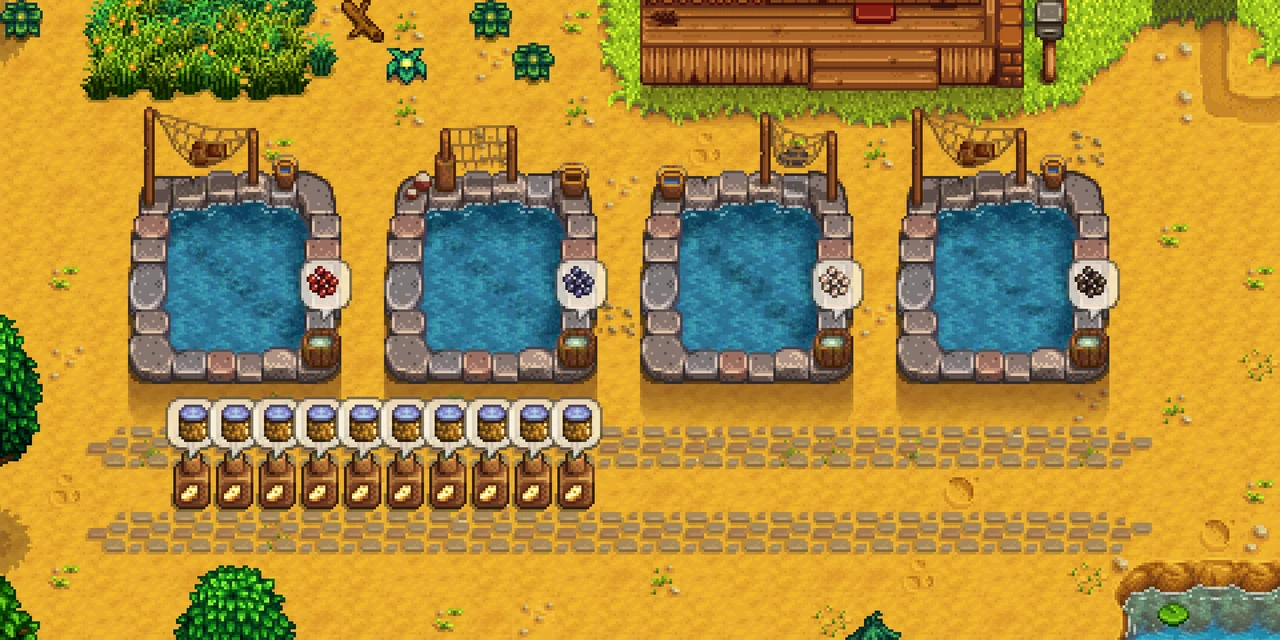
PELICAN TOWN – The fish pond is the Valley’s most underexamined building. Nearly every farm puts one Lava Eel into one pond, collects whatever appears, and never asks the follow-up question: almost any fish can be ponded, each with its own product table, and every pond consumes three scarce things at once. It takes 25 tiles of land, it takes Preserves Jar capacity to process its roe, and it takes attention, because its population grows only when its quests are served. The Journal built the full league table at population ten, priced the roe pipeline per jar-day, and put the standing question to the numbers: is any pond besides Lava Eel and Sturgeon worth its footprint?
§1How a pond actually produces
The building costs 5,000g, 200 Stone, 5 Seaweed, and 5 Green Algae, occupies a 5×5 footprint, and holds one species at a population of one to ten. Legendary fish are refused, and the fish are never consumed, so a stocked pond is a perpetuity. Each morning the pond passes a gate of 15% plus 8% per fish (23% at one fish, 95% at ten) and then rolls once on the species’ product table. One product per day is the ceiling, and an uncollected product is replaced rather than stacked, so the daily collection walk is part of the price. Population ten is therefore not a luxury; it is the entire business case.
Roe sells for 30g plus half the fish’s base price, which is why expensive fish make expensive roe: the 700g Lava Eel yields 380g roe and the 200g Sturgeon yields 130g. In a Preserves Jar, roe becomes Aged Roe worth exactly double after 4,000 machine-minutes, or 2.5 jar-days. Sturgeon roe alone becomes Caviar, worth 500g after 6,000 minutes, or 3.75 jar-days. Artisan adds 40% to both. Growth is the slow part. Fish reproduce every one to five days, scaled by price, but at populations 3, 5, 7, and sometimes 9 the pond halts growth and requests an item. Lava Eel’s ladder runs Fire Quartz, then Basalt or 2 Diamonds, then 2 Mega Bombs, then 1 Iridium Bar. Production continues while a quest is pending; only growth stops. With prompt service the ramp from one fish to ten takes 45 to 60 days.
Gross gold per pond-day at population 10 · all roe processed with Artisan · SDV 1.6
§2Reading the league table
The gap between fourth and fifth place is the chart’s message. Stonefish, the best of the rest, earns a third of Lava Eel, and everything below it earns less than a single good crop tile. The answer to the standing question is therefore precise: exactly two more ponds are worth building for gold, Ice Pip and Blobfish, and both are easier to stock than the champion. Ice Pip is caught at mine level 60 and Blobfish from the Night Market submarine, while a Lava Eel must be pulled from the floor-100 lava at a bite rate the research series puts near 7%. One eel is enough, since reproduction does the rest.
§3The two hidden bills: tiles and jars
Measured per tile, a full Lava Eel pond is one of the best land uses in the game: 1,170g across 25 tiles is about 47g per tile-day, the same class as a blueberry field run through an Artisan jam pipeline at roughly 45 to 55, except that the pond needs no water, no fertilizer, and no season. The only all-season competitor at its level is the greenhouse. A Sturgeon pond works out to 27g per tile-day, matching ordinary raw cash crops at roughly 25 to 40 while working through winter, and a Spook Fish pond at 15 loses to planting almost anything.
The jar bill is where the audit found its surprise. This desk’s juice audit established the pumpkin pickle as the best vegetable use of a jar. Aging lava eel roe beats it: (1,064 − 380) ÷ 2.5 = 274g per jar-day, the new best-in-class jar job. Ice Pip and Blobfish roe add 202. Caviar, against expectation, is mediocre: (700 − 130) ÷ 3.75 = 152g per jar-day, below the pickle. Sturgeon ponds are good businesses because their roe is nearly free, not because the caviar step is efficient. The desk budgets 2.5 jars per roe pond (3.75 for Sturgeon) to keep pace with production, which means a four-pond operation wants a dedicated bank of ten jars.
Value added per Preserves Jar-day · Artisan · SDV 1.6
§4The utility ponds, paid in goods
Below the gold line sit ponds whose case is not gold at all. A Midnight Squid pond makes about one squid ink a day; ink sells for little, but it gates the Squid Kid quest and several tailoring and cooking uses, and the pond is the only renewable tap. Void Salmon supplies void essence and the occasional Void Egg, the only way to start a void chicken line without the Witch’s random visit or 5,000g at Krobus. Octopus ponds drop omni geodes at high population. Slimejack makes slime without a hutch, at worse rates, and is correct only for farms that refuse to build a Slime Hutch. Blobfish appears here deliberately a second time: beyond its gold rank, about half of its non-roe rolls are Farm Warp Totems, a renewable fast-travel budget until the Return Scepter’s 2M. Coral and Sea Urchin pond as well, despite not being fish, and produce more of themselves at trinket prices; the desk classifies them as landscaping. The Tiger Trout is the easter egg: a sterile hybrid that cannot reproduce, so all ten must be caught by hand for a mid-table roe pond. It is built for love, not money.
§5The lottery tickets, priced
The Rainbow Trout shard pond is the community’s favorite fish-pond fact and, on the arithmetic, the worst advice in this market. At 0.1% per production day, after its 2% shell roll fails, the expected wait for one Prismatic Shard is about 2.9 in-game years, worth roughly 2g a day, during which the pond earns a sixth of a Lava Eel. A farmer who wants a shard can take the jade staircases from this series’ Crystalarium work and fetch one in an afternoon. The Blobfish pearl is the opposite case: a 2% daily chance at a 2,500g Pearl is a real 50g-a-day annuity hiding inside an already-good pond. The Sturgeon’s roughly 0.5% Diamond is pleasant noise, and the Spook Fish’s roughly 1.5% treasure chest is material.
§6The ramp, the map, and the 1.6 cracker
The real cost of a pond is its first fifty days. It spends them below population ten, producing at a fraction of list rate while demanding quest items, and the Lava Eel ladder peaks at an Iridium Bar. The desk’s practice is to stock a pond the moment its fish is catchable, book quest items as capital expenditure, and never judge a pond by its first month. Ponds are also the ideal tenant for land crops cannot use: the Riverland farm’s scraps, the Beach farm’s sand, where sprinklers fail but ponds do not care, and the awkward corners of every map. Their labor profile, one collection walk and zero watering, makes them the best passive layer under an active Skull Cavern schedule, since a pond works identically on the days its owner spends six hundred floors down.
Version 1.6 adds one clause that rearranges endgame priorities. A fish pond accepts one Golden Animal Cracker, permanently doubling its output; the patch notes that closed the cracker’s exploits confirm the feature. On a Lava Eel pond the cracker is worth about 1,170g a day, and since pigs still refuse crackers, the first two belong to ponds, Lava Eel first and then Ice Pip or Blobfish, ahead of any barn animal on raw gold per cracker. One correction for the record: the proposal memo behind this audit guessed that Coral ponds might mint Treasure Hunter bait. They do not. Specialty baits are Fishing Mastery craftables, and Coral ponds make coral. The memo’s core suspicion, that the community sleeps on the second tier, survives contact with the numbers.
§7The verdict
Four ponds are worth building for money, in this order: Lava Eel, Ice Pip, Blobfish, Sturgeon. Each should be pushed to population ten immediately, the first Golden Animal Cracker should go to the Lava Eel, and ten Preserves Jars should be banked for the roe, because the lava eel jars are the best jars on the farm. Utility ponds earn a place only for goods the farm actually consumes, and only on tiles crops cannot use. The Rainbow Trout lottery and the crab-pot fish are both passes. The building’s real identity, as the desk reads the ledger, is not a fishery at all. It is the only crop in the game that grows in winter, on sand, unwatered.
J1 · The league table
| Pond | Fish base | Roe → processed | Gold per pond-day | Notes |
|---|---|---|---|---|
| Lava Eel | 700 | 380 → 1,064 | 1,170 | roe + spicy eel, gold ore, magma geodes |
| Ice Pip | 500 | 280 → 784 | 709 | roe + iron ore |
| Blobfish | 500 | 280 → 784 | 687 | roe + 2% Pearl, warp totems |
| Sturgeon | 200 | 130 → 700 | 665 | all roe, jarred to caviar |
| Stonefish | 300 | 180 → 503 | 454 | roe + copper ore |
| Spook Fish | 220 | 140 → 392 | 365 | roe + rare treasure chest |
| Tiger Trout | 150 | 105 → 294 | 279 | roe only; cannot breed |
| Super Cucumber | 250 | 155 → 434 | 265 | roe diluted by amethyst, iridium ore |
| Void Salmon | 150 | 105 → 294 | 255 | roe + void essence |
| Midnight Squid | 100 | 80 → 224 | 211 | roe + squid ink |
| Rainbow Trout | 65 | 62 → 173 | 163 | roe + 0.1%/day Prismatic Shard |
Per tile-day: Lava Eel 47 (1,170 ÷ 25), Sturgeon 27 (665 ÷ 25), Spook Fish 15 (365 ÷ 25), against blueberries with an Artisan jam pipeline at ~45–55 (summer only, watered) and an average raw cash crop at ~25–40.
J2 · Production mechanics & the jar budget
Daily gate: 15% + 8% × population, so 95% at 10. Roe: 30 + floor(base ÷ 2). Aged Roe: 2 × roe, ×1.4 Artisan, 4,000 machine-minutes (2.5 jar-days). Caviar: 500, ×1.4 Artisan, 6,000 minutes (3.75 jar-days). Lava Eel at population 10: Roe ×1 64%, ×2 13%, ×3 3%, Gold Ore ×5 7%, Spicy Eel ×5 4%, Magma Geodes 1.8%/3%, nothing 5%: 0.99 roe a day plus 116g a day of by-products. Other species use conservative roe shares: Ice Pip 0.90, Blobfish 0.80 plus 2% Pearl and totems, Sturgeon 0.95, Super Cucumber diluted to 0.48 by mineral rolls.
Jar budget: 2.5 jars per roe pond, 3.75 for Sturgeon; ten jars for a four-pond operation. Quest ladder (Lava Eel): Fire Quartz; Basalt or 2 Diamonds; 2 Mega Bombs; 1 Iridium Bar. Production continues during a pending quest; only growth stops.
J3 · The lottery tickets
| Jackpot | Chance per day (pop 10) | Expected wait | EV per day | Verdict |
|---|---|---|---|---|
| Rainbow Trout: Prismatic Shard | 0.1% (after 2% shell roll fails) | ~2.9 in-game years | ~2g | Meme |
| Blobfish: Pearl (2,500g) | 2% | 50 days | 50g | Real income line |
| Sturgeon: Diamond | ~0.5% | 200 days | 5g | Pleasant noise |
| Spook Fish: Treasure Chest | ~1.5% | 67 days | ~75g | Material |
J4 · Methodology & sources
Jar value added = (processed − raw roe) ÷ jar-days. By-product prices: Spicy Eel 175, Gold Ore 65, Magma Geode 150, Pearl 2,500, Squid Ink 110, Iridium Ore 100. All figures are expected values at population 10 with Artisan held. The pumpkin-pickle benchmark appears as 245g per jar-day in this desk’s juice audit and as 246g in the pond paper; both are shown. The shard-staircase comparison draws on the research series’ Crystalarium paper, which the Journal has not yet published as an article. Sources: Stardew Valley Wiki pages for Fish Pond, Modding:Fish Ponds (production gate), Lava Eel, Roe, Aged Roe, Caviar, and each fish cited (1.6 revisions).